

Happy New Year! I hope you had a wonderful Christmas and New Year celebrations. We went to Center Parcs in Woburn for Christmas which was busy but very enjoyable. They make the forest look very magical and it was lovely to go swimming on Christmas Day.
It was my husband’s birthday on New Year’s Day and it’s quite a tricky day to celebrate as a lot isn’t open. He absolutely loves snowboarding and I obviously couldn’t take him to Austria for one day so I booked the next best thing, our local snow sports centre! He had an hour and a half snowboarding while the kids went on a toboggan ride and went sno-tubing. He was enjoying being back on the slopes until he took a bit of a tumble and unfortunately as a result has broken his wrist. He is very much a glass half full kind of person though and said he had a really good birthday!
Do you have any New Year resolutions? I don’t necessarily have resolutions but I do have goals and one of them is to do with my business. With the new year comes new plans and for Sophie Laws Interiors I am proud to announce that I will be including neurodivergent design within my services. As you may know, I have personal experience with neurodiversity within my family and where your home is your safe space, your sanctuary, a place where you can unmask, it’s imperative that you design your home to accommodate that.
It is estimated that 15% of the Global population and 15-20% of the UK population are neurodivergent, a figure that is growing as awareness increases. Common conditions include autism (over 1 in 100 in the UK), ADHD (3-4% of UK adults), dyslexia (10% of the UK population), and dyscalculia (about 7% of all ages).
My main design focus is residential interior design, in particular, busy family homes which need to be functional and practical but also somewhere you can’t wait to get to after a busy day. With that in mind and with figures increasing, it is important that when I am designing a home for a family I take in consideration the special requirements of all members of that household.
If you follow my social media you may have seen my post in December with 5 design tips for a neurodivergent home. There are so many more than just 5! Also, what may work with a child with ADHD may not work with an adult with Autism so it is imperative to consider all the family’s needs.
There is no definitive number of neurodivergent conditions because the term covers a wide and evolving range of conditions, and some sources include different types of conditions. However, I can name at least 13 and with that in mind I have my work cut out!
This month I am particularly looking at ADHD in children. This is a neurodevelopmental disorder characterised by inattention, hyperactivity, and impulsivity and can interfere with daily functioning.
Symptoms Include
Inattention:
Easily distracted and forgetful
Trouble following instructions or completing tasks
Difficulty organizing belongings and schoolwork
Losing things frequently
Hyperactivity:
Fidgeting, squirming, or tapping hands and feet
Restlessness or being "on the go"
Difficulty staying still or doing quiet activities
Talking excessively
Impulsivity:
Acting without thinking of the consequences
Difficulty waiting for their turn
Interrupting conversations
To create an ADHD friendly home the focus needs to be on creating a calming, organised, and distraction-free atmosphere. Children with ADHD need a comforting environment to support their needs. One key element to this is to reduce distractions. Organised, clutter free spaces will promote more focus as chaos and busy environments will cause stress and limit their ability to concentrate. Use labels and visual cues to encourage a consistent routine.
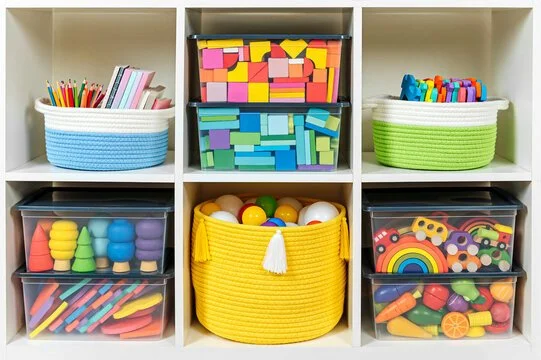
Organised toy area
Have a separate space for homework than you do for play to avoid over stimulation and the homework space should be tidy. Too many items on shelves or on the desk can be distracting and therefore reduce their concentration on their homework. It’s useful to have a calm nook, somewhere to relax and unwind. Even if you don’t have a large space for this, a teepee in a bedroom can be erected and filled with soft cushions and blankets, giving them a cosy space to retreat to if needed.
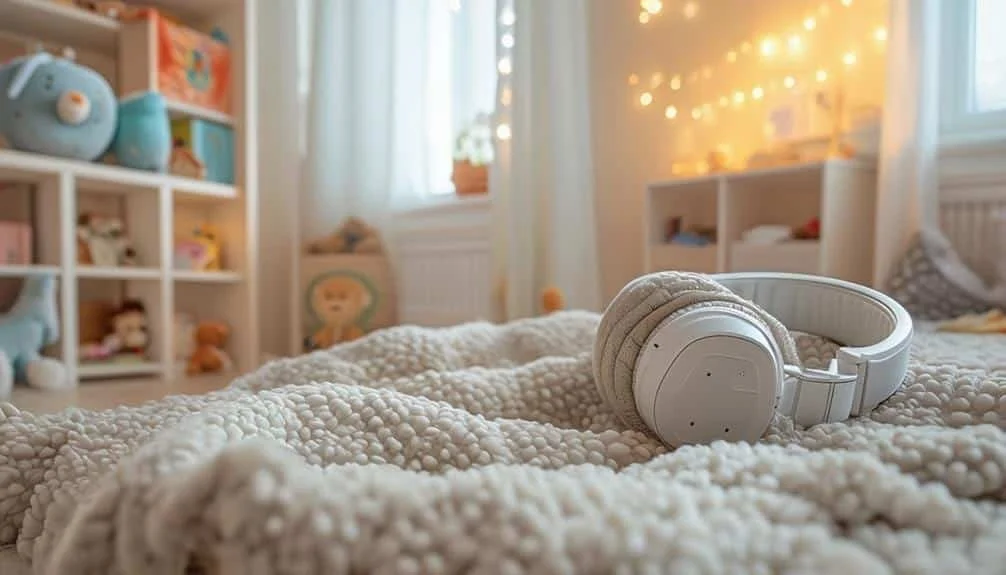
Soft blankets to provide comfort, headphones to retreat
In terms of décor, soft, muted colours such as blues, greens, neutrals and pastel colours will promote a sense of calm. Avoid bright vibrant colours as this will overstimulate them. Where possible use dimmable lamps and lights rather than bright lights as they can be overwhelming. Blackout blinds and curtains will help aid sleep. Simple, minimalist décor, limiting busy patterns will help create a calm, relaxing environment for a child with ADHD.
There is of course a lot more to it and planning the design of a space for a child with ADHD takes a lot of consideration. I am currently in the process of creating a digital guide which will be available to purchase soon so keep your eyes on my social media for the release date.
Do you have a neurodivergent member of your household? Would you like help and support to create them a space where they feel happy, comfortable and safe? If so, please contact me via email sophielawsinteriors@outlook.com or have a look at my website, www.sophielawsinteriors.co.uk and I will be so excited to help you make your space a happy place!